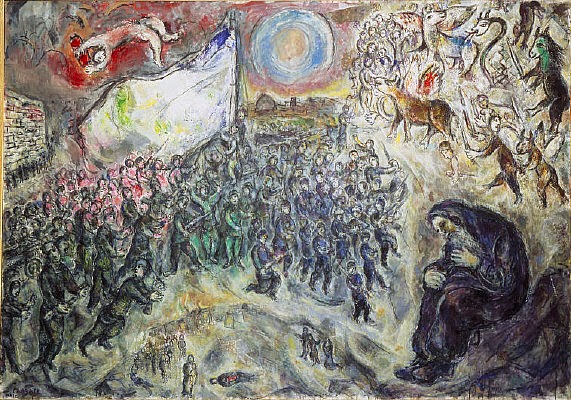
Painting: The Prophecy of Isaiah by Marc Chagall, 1960’s
Isaiah 1-5: God’s Approaching Salvation Through Judgment
Isaiah chapters 1-5 stand as an overture to the book of Isaiah. Here, God reveals His verdict of judgment against Israel and the reasons why He has a controversy with her. She is described as rebellious, her religion insincere, desperately wicked, and near to be destroyed unless the Lord had mercy. Yet the Lord remains steadfast in His promises to Israel and shows that through His judgments Israel would in the end be called “the city of righteousness, the faithful city,” with repentance and true worship restored (Is. 1:26).
We are told that this final restoration of Israel would be eschatological and to be fulfilled “in the latter days,” and in “the day of the Lord” (Is. 2:2, 12). Wherein, Israel will be the place the Lord establishes His throne and kingdom, through which all nations would be taught God’s ways. God shows that in the end she truly will be a blessing to all nations, “For out of Zion shall go forth the law” (Is. 2:3). Though God speaks through Isaiah of an immediate judgment and restoration, He certainly speaks of a final judgment and restoration. For, the restoration described ends with fantastic promises such as: God dwelling in her midst, an end to all wars, and Israel’s mission being brought to full completion.
Isaiah continues to describe how the Lord will execute His discipline on Israel. Every area of Israel would be touched by God’s judgment from the highest leadership down to the individuals of the nation, yet sparing the righteous (Is. 3:4). God promises to take away the sustenance, the strength, and the beauty of Israel so that her spiritual depravity would be realized physically and she would be humbled and cleansed. Through the “spirit of judgment and by the spirit of burning” the Lord works to create in Israel a dwelling place for himself and works to bring Israel’s mission to completion (Is. 4:4). These themes end in song as God’s heart is revealed over Israel in His judgments as though He were pleading His case in warnings.
Isaiah 6-8: Immanuel, God with Us
Isaiah sees the Lord enthroned, comes to despair at the revelation of his sin and that of the nation, is cleansed, and receives his divine commissioning to be a prophet. Yet the affect of his ministry is revealed to, in affect, “Make the heart of this people dull,” (Is. 6:10). Isaiah is told that this would continue until the land is “utterly desolate,” and “only a tenth spared” (Is. 6:11, 13). God describes the remnant of Israel that is spared as a stump left in Israel’s desolate midst.
With the northern king of Israel and the king of Syria closing in on Ahaz in Judah, Isaiah instructed the king to trust in the Lord and ask for a sign, but Ahaz would not. Nevertheless, the Lord indeed gave a sign anyway; the sign of “Immanuel,” which means “God with us” (Is. 7:14). The sign would show that Ahaz’ rivals would soon be uprooted. This passage necessitates an eschatological fulfillment for the whole of Scripture depicts an ultimate salvation of Israel where God would truly dwell in her midst. Ahaz’ foolish response to the Lord earned him the consequence of the king of Assyria, whom Ahaz trusted, bringing Judah to ruins and devastation. Even those left would “eat curds,” because Judah’s agriculture and economy would be so devastated (Is. 7:22).
Isaiah was to write and then later name his child “Maher-Shalal-Has-Baz” signifying that within about a year the two kings of northern Israel and Syria would be“taken away” (Is. 8:1-4). Nonetheless, the king of Assyria would conquer through Judah, even reaching “up to the neck” (Is. 8:8). Uniquely, this message was spoken to the Immanuel figure, saying the calamity would happen to“Your land, O Immanuel” (Is. 8:8) and concludes that the nations that gather against the Lord would be shattered. God would become to some a “sanctuary” and to others “a rock of offense” (Is. 8:14) separating the righteous remnant from the rest. The passage ends with how hardened the wicked become as God releases His judgments.
Isaiah 9-12: Victory Through the Messiah
The northern tribes who were “lightly esteemed” as seen in the previous chapters of their severe punishment under the Assyrian invasions, would be the first to see the victory of their Messiah (Is. 9:1). Messiah is shown as a great light shining in the darkness, causing Israel to “rejoice” in victory.The victory through the Messiah is compared to that of Midian when Gideon’s small weak army miraculously got the victory through God (Is. 9:3; Judges 7). Once again, a child figure is introduced, this time He is named, “Wonderful, Counselor, Mighty God, Everlasting Father, Prince of Peace,” (Is. 9:6) Such language reserved for God is ascribed to this child who is “given”, builds upon the former Immanuel figure, and reveals God’s descending to man and taking on his human frame (Is. 9:6; Phil. 2:6-11). Nonetheless, Israel who is not yet ready for Messiah is promised judgment as three times it is repeated in God’s released judgments, “For all this His anger is not turned away, But His hand is stretched out still” (Is. 9:21).
The Lord taunts Assyria in her pride and reveals that she is no more than an “ax” in God’s hand and equal to all the other kings of the earth who are God’s “princes” (Is. 10:8, 15). Although Assyria would be used by the hand of God to punish Syria and northern Israel, because of Ahaz’ rebellion Assyria in turn would also judge Judah. Nonetheless, in the end, Assyria will be judged, for God is sovereign. Such was the case, for 185,000 Assyrians would be killed in one night in their approach to Jerusalem (1 Kings 19:36-37). In this, God is depicted as though He were chopping down trees: “He will cut down the thickets of the forest with iron, and Lebanon will fall by the Mighty One” (Is. 10:34).
The perfect character of the Messiah who has “the Spirit of the Lord” resting “upon Him” is depicted (Is. 11:2). Also depicted is Messiah’s humanity, “a Rod from the stem of Jesse,” and His divinity, “a Root of Jesse” (Is. 11:1, 10).Under the reign of Messiah even nature is transformed until the lion is a herbivore and the weakest child playfully leads what are now deadly animals. This glory of the Messiah reaches to the Gentiles and the exiles of Israel return the kingdoms of Israel restored in unity and return as in the time they came up from Egypt.
God’s salvation is exclaimed among the nations; for, in contrast to previous judgments, God’s anger has turned away and worshippers declare “his deeds” to all people (Is. 12:4). This speaks of an ultimate salvation through Messiah wherein God makes His dwelling place in the “midst” of Israel (Is. 12:6).
Isaiah 13-23: Immanuel Exalted Among the Nations Through Judgement
Where Isaiah 1-12 deals with God’s judgments against Israel and Judah and ends in exultation of Immanuel’s future reign, chapters 13-23 are ten oracles that deal with the judgment of Babylon and the surrounding nations and point back to Immanuel’s future reign. Beginning with God’s judgments against Babylon (who, at the time, was not a world empire but a prominent city), this burden Isaiah received reveals how accurately God reveals what is to come to his prophets; for, about 100 years after Isaiah’s death Babylon would conquer Jerusalem and destroy the temple. Isaiah speaks of Babylon’s destruction in the prophetic tense, using the term “the day of the Lord” twice, for Babylon throughout the testimony of Scripture speaks of an archetype of the culmination of the idolatrous opposition of nations against God (Is. 13:6, 9; Rev. 17, 18; Zech. 5). Therefore, the overthrow of the end of the age harlot Babylon will be utter, “as when God overthrew Sodom and Gomorrah” (Is. 13:19). As confirmation of this future ultimate fulfillment, the Medes truly did come up against Babylon and conquered them in 539 BC through King Cyrus of Persia. This judgment against Babylon and the nations is in direct accordance with God’s continual choice of Israel through whom He promises to set up His eternal Kingdom, saying “For the LORD . . . will still choose Israel” (Is. 14:1). Israel is promised to return to the land and be fully restored “in the day” that the proverb against the King of Babylon is taken up which ultimately speaks of the fall of the king of spiritual Babylon, Satan (Is. 14:3, 12; Ez. 28:14-16; Rev. 20:10).
Furthermore, God takes up oracles against Philistia, Moab, Israel, Egypt, Babylon again, Edom, Arabia, Jerusalem, and Tyre. These oracles contain the ongoing theme of ultimate judgment of Israel and the nations unto an ultimate restoration “in that day”, or at the end of the age (Is. 19). Within these ten oracles we find Israel will be reduced to a remnant: “. . . the glory of Jacob will wane . . . like the shaking of an olive tree, two or three olives at the top . . .” (Is. 6:13, 17:4-6) before they are regathered from the nations to the land as the Lord again “will still chose Israel and settle them” (Is. 11:11, 14:1). The destruction of Satan, the King of Babylon as already stated will coincide with an ultimate judging of nations. As the nations “rush” against God he “will rebuke them and they will flee far away . . .” (Is. 17:13). Nonetheless, just as God cleanses Israel through judgment the nations too will be cleansed and restored into right relationship with the God of Israel; for, what would be unthinkable to say of Egypt and Assyria is said: “Blessed is Egypt My people and Assyria the work of My hands, and Israel My inheritance” (Is. 19:23-25; 23:17-18). In conclusion, Immanuel will usher in true world peace with Himself through His divine judgments.
Isaiah 24-33: Immanuel’s Kingdom Come Down
Isaiah 1-12 deals with God’s judgments against Israel and Judah and ends in exultation of Immanuel’s future reign then chapters 13-23 document ten oracles that deal with the judgment of Babylon and the surrounding nations and points back to Immanuel’s future reign. Now in this section of Isaiah 24-33 the prophet points to the eschatological culmination of human history when Immanuel’s Kingdom comes to the earth. It is eschatological, taking place “in that day”
when “the Lord will punish on high the host of exalted ones, And on the earth the kings of the earth” (Is. 24:21). This leveling of earthly kingdoms is in the midst of Israel’s greatest experience of treachery by the nations she put her trust in above her God (Is. 24:16 with 31:1, 2 Kgs 18:13-17 and Dan. 9:27-28) and the earth’s greatest physical tribulation and shaking (Is. 24:18-20). Just as Israel is reduced to a remnant, so is the earth (Is. 24:13 with 6:13). Remarkably, what arises from these greatest troubles is a worship movement “from the ends of the earth” ushering in the City of God “which cannot be shaken” (Is. 24:16; Heb. 12:25-29).
When the Lord inaugurates His Kingdom on earth He will “make for all people a feast” (Is. 25:6); “all people”, for at this point all wicked are removed. In His Kingdom come, death is defeated and all tears are wiped away, placing the fulfillment of this prophecy at the end of the Millennium after the Second Coming of Christ (Is. 25:8 with Rev. 21:4 after Rev. 20). “In that day” a song is sung “in the land of Judah,” singing, “Open the gates , That the righteous nation which keeps truth may enter in” (Is. 26:1-2). This speaks of the national salvation and restoration of Israel specifically (Is. 26:19, Rm. 11:15, 26). Where God was once sorely displeased with His “vineyard”, Israel, He is now delighted (Is. 5:7, 27:2). “In that day” that Satan, or “Leviathan” is completely destroyed and God conquers Israel’s enemies, the “children of Israel” will be “gathered” out of exile and out of danger in Assyria and Egypt back to the land “one by one” to “worship the Lord” (Is. 27:1,12-13).
In light of God’s promised ultimate salvation of Israel, Isaiah 28-33 zeros in on Israel’s rebellious leadership with six woes. They are essentially one woe against Israel who instead of trusting in the Lord are trusting in foreign alliances. Such a heart posture culminates“in that day [of] the Lord” and God promises them swift judgment though He is simultaneously a refuge for “the remnant of His people” (Is. 28:5). For in that day, their trust in other nations is to the greatest level as they make “a covenant with death”, which is to say a covenant with Satan; yet, the Lord who is faithful in midst of her rebellion will “lay in Zion a stone for a foundation”, which is to say the inauguration and coming down of the Kingdom of God through Messiah (Is. 28:15, 16 with Dan. 9:27-28). God’s “unusual act” of His “destruction determined even upon the whole earth”, proves to exalt His glory (Is. 28:21, 29). Despite the rebellion of Israel’s leadership, who’s understanding and wisdom perish as they “seek deep to hide their counsel far from the Lord”, God promises to humble the proud and teach those who were in error “in that day” of the Lord’s return (Is. 29:1, 24, 18). Israel has forgotten that the Lord has formed her and called her out of Egypt and is now, in fact, finding refuge in the Pharaoh that once enslaved them, as it were (Is. 30:2). God promises to humble proud Israel through causing the nations she trusts in to fail her. It is this “iniquity” and those who partake in it that the Lord promises to break in pieces like a “potter’s vessel” (Is. 30:13). Though Isaiah sees “a king will reign in righteousness”, presently Israel is prepared for swift captivity, even “in a year and some days” (Is. 32:1, 10) This captivity would be fulfilled by Nebuchadnezzar in 586 BC, who destroyed Jerusalem only 115 years after Sennacherib attempted to do the same. Yet after such judgment and cleansing God promises to hear the prayers of His people and fully heal them, restore their land, and conquer her enemies. God promises to “Now . . . rise . . . [and] be exalted” and act as Israel’s “Judge”, “Lawgiver”, and “King” which will manifest through His redemptive acts in the Messiah; for to Israel God promises, “Your eyes will see the King in His beauty” (Is. 33:10, 22).
Isaiah 34-39: Ultimate Judgment Unto Ultimate Restoration – Three Tests for Israel
Isaiah has thus far led the reader through God’s judgments against Judah (chapters 1-12) unto God’s judgments against Babylon and surrounding nations (chapters 13-23), unto (chapters 24-33) the eschatological culmination of human history when Immanuel’s Kingdom comes to the earth. Now Isaiah hones in on the ultimate day of judgment unto the ultimate day of redemption. That is, God’s global end-time judgments at “the Battle of Armageddon” unto the Millennium (Rev. 16:16, 20). As it is written, “For the indignation of the Lord is against all nations” (Is. 34:2). Edom, Israel’s chief enemy of all time is reduced to hell on earth, whose “smoke shall ascend forever”, standing as an example of how God will judge nations according to their relationship with Israel in the end of the age (Is. 34:10; Mt. 25:31-46). Yet, the judgment ends in world peace; for, God, through judgment cleanses and causes “the desert” to “rejoice and blossom” (Is. 35:1) The people of God are encouraged to be strong as they await God’s judgment and their entrance into the Millennium via “the Highway of Holiness” which they experience with joyous shouts (Is. 35:8). Therein is full restoration of body, soul, and earth.
Furthermore, God’s interactions with Hezekiah reveal unique tests of faith for Israel to learn for her future. When Assyria came against Jerusalem with great threats, having conquered “all the fortified cities of Judah” and blaspheming the God of Israel, Hezekiah remained steadfast and trusted in the Lord for salvation in prayer and received God’s promise of protection (Is. 36:1). For Hezekiah’s faithful intercession, God conquered the Assyrian army on his behalf (Is. 37). Next in the storyline presented in Isaiah, Hezekiah experiences a physical sickness unto death, yet he again turns to God in prayer for a miracle. It is granted, causing the king to rejoice in song (Is. 38). However, when the king of Babylon came in peace to the king, he did not resist and exposed to Babylon all of the riches of his house. In response, God promised the future Babylonian invasion that would occur in 586 BC. This stands as a lesson for Israel in the end of the age to not merely trust the Lord in threats and sustenance of life, but to trust in the Lord by forsaking alliances with the nations.
Isaiah 40-48: God, The Only Deliverer
Where the last section ended in the prediction of sure coming judgment, Isaiah 40 opens up in as if Israel were already in that judgment. This section until the end of Isaiah carries a main theme of “comfort”: that God has not forsaken Israel whom He is in covenant with. An end-time captivity and redemption is pictured in which, truly, “her warfare is ended” and “her iniquity is pardoned” (Is. 40:2). Israel’s accusation that God does not see nor act on her behalf is met by God’s answer of a foreknown plan of redemption in His faithfulness, that is beyond what humanity can attain on their own, who’s strength and lifespan is equated to grass.
God speaks asking, not just Israel but all the earth, “who raised up one from the east?” and introduces a conqueror that Isaiah would later identify by name as Cyrus is called the Lord’s “shepherd” and the Lord’s “anointed” who would “subdue nations” and decree for exiles to return and rebuild Jerusalem, as was fulfilled in 538 BC (Is. 44:28, 45:1). God’s ability to sovereignly call forth a deliverer from the Gentiles and foreknow it, stands as a judgment against the idols that relied on their makers to“not totter” and against unbelief (Is. 41:7) Israel, who is in a very precarious position, like a “worm”, God promises to make like “a new threshing sledge” to break down mountains (Is. 41:14-15). God, in so doing, is revealed as sovereign over all the nations who, in turn, would come to worship Him and abandon idolatry when Israel is fully vindicated (Is. 45:14, 22).
“Behold! My Servant whom I uphold,” opens the first of five servant songs that tell of the Servant of the Lord, who fulfills the mission of Israel and is juxtaposed against natural Israel who is described as a deaf and blind messenger in this present age (Is. 42:1, 18; Rom. 10). The New Testament ascribes these servant songs as fulfilled by Jesus (Mt. 13:17-21; Jn. 12:38). This Servant is shown as bringing “justice to the Gentiles” in a gentle way. He produces a worship movement that declares God’s praise to the eradication of idolatry.
Despite Israel’s current inability, God yet promises to completely deliver her in His grace and love (43:1-7). He calls to remembrance His creation of Israel and the way He saved her from the nations. It is He who determines her future and not her failures. He promises to dramatically re-gather her from the ends of the earth (49:22-23), as is depicted as a second Exodus in Isaiah (Is. 43:16-20, 63:11-14). The ability of God to save, who has always carried Israel, stands as a judgment against the idols who are carried away into captivity (Is. 45:20-25, 46:1-7). This rolling judgment against idolatry culminates in the judgment of Babylon who, throughout the Bible, symbolized the height of human idolatry and retaliation against God. She is here judged for the height of her pride and her merciless treatment of Israel (Is. 47:6-7, 10) God shows that it was He who used Babylon to discipline Israel but now would, in turn, judge her. This was partially fulfilled when Cyrus defeated Babylon in 539 BC but an end-time fulfillment is seen described in Revelation 17-18. During their captivity He addresses Israel to listen and believe. God, who has not forsaken Israel in midst of her rebellion, remains gracious, in pursuit of her, and able to deliver.
Isaiah 49-53: God: Servant, Sacrifice, and Savior
Where the last section proves the sovereignty of God and His ability to deliver Israel, this section moves into the way in which He will do so. The second servant song opens up with the words, “Listen, O coastlands, to Me,” as being directly spoken by the Servant to the nations (Is. 49:1). The Servant is divinely “called from the womb”, which stands as a culmination of expectation for the birth of a deliverer (Is. 49:1, 7:14, 9:6). The Servant would fulfill all of Israel’s covenantal requirements, being given “as a covenant to the people” to bring redemption to Israel and to the Gentiles (Is. 49:8). Where Cyrus is a servant used to deliver Israel from captivity, this servant accomplishes cleansing Israel from her internal sin problem which had caused her to go into that captivity. Where Israel was previously delivered from exile, here, a global redemption is announced through the Servant who is given “as a light to the Gentiles” (Is. 49:6, 13). There follows expectation of a final redemption.
The third servant song shows that the Servant is in full agreement with God. To the Gentiles, the Servant is a light bringing the globe to glorify God (Is. 49). To God, the Servant is fully yielded in obedience and points directly to Him (Is. 50:4-10). To Israel, the Servant is her forerunner and ideal representative. In His victory He fulfills (and causes her to fulfill) her calling (Is. 51:4-6). In the midst of Israel’s inability to fulfill her calling on her own, the Servant is God’s solution.
As in the last section, there remains a theme of God’s faithfulness to Israel despite her failures and His faithfulness is His answer to her complaint that “The Lord has forsaken me, And my Lord has forgotten me”, which is pictured as a divorce certificate (Is. 50:1-2; 49:14). He argues with Israel that He, as Creator and God of the Exodus, is not only able to deliver but desires to (Is. 50:2-3, 51:12-16). God implores Israel three times to “Listen”, to remember and believe that God has done and his faithfulness of what He promises to do (Is. 51:1, 4, 7). That His salvation will come and all the earth would be brought into His law. Again, a second Exodus is cried out for, as also seen in the last section (Is. 51:9-11). In response to this need and cry for deliverance, she is called to “awake” and stand in strength after her previous judgment and punishment; she is called to now “put on strength” (Is. 51:17, 52:1). This is a prophecy of God’s final vindication of Israel and His name. It speaks of an eschatological fulfillment where Israel is redeemed out of her final and greatest oppression by “the Assyrian” (Is. 52:4). Their deliverance is to the uttermost and leadsthem to flourish in the knowledge of God.
The fourth servant song proclaims the salvation of God through His provided atonement for Israel and all nations (Is. 52:14, 53:5). It here becomes apparent that the Servant, Himself, is Savior, Sacrifice, and Great High Priest (Is. 53:6, 12). The Servant is pictured as suffering and dying yet is exalted and His work proves fruitful and successful (Is. 52:13, 53:11). Herein is everything that pertains to atonement for sin. Herein, God enters into Israel’s very exile at the very root of all that separates man from God – internal iniquity and it’s counterpart of external oppression.
Isaiah 54-59: An Invitation to Enter into the New Covenant
In the last section the Servant has paved a way for all to come to salvation. Here, this section opens an invitation to come into and have joy in that provided deliverance and salvation. The command to rejoice in that which has not yet manifested stands as confirmation of the surety of success of the Servant’s mission. Nonetheless, there is a clear aspect of Israel being required to receive with faith and intentionally enter into that now-but-not-yet salvation with the words, “Sing,” . . . “enlarge,” . . . and “do not fear” (Is. 54:1-4). He promises Israel that she will be the head of the nations, enlarged, strengthened, and will forget her past suffering. In this is a picture of a new covenant, even as God compared the promise of this full restoration to “the waters of Noah” (Is. 54:9). Just as He swore to never destroy the earth again with a flood, so He swears to Israel to never be angry with her or rebuke her again. The pictured restoration of Jerusalem is so harmoniously reflected in the New Jerusalem of Revelation.
God will restore Israel back to Himself and His salvation is freely given because of the Servant’s payment as seen in the previous section. Again, “an everlasting covenant” is mentioned and at it’s center is the accomplished work of the Servant. In this is not merely a return from exile but of a global invitation to be reunited to God. Intentionality to enter in is again stressed in the words “listen,” . . . “incline your ear, and come to Me,” . . . “hear,” . . . “seek the LORD,” and “call upon Him” (Is. 55:3, 6).
Again, God highlights His “covenant” (Is. 56:4). In the fulfillment God’s covenant, provided by the Servant’s work, the Temple is now called “a house of prayer for all nations” (Is. 56:7). Gentiles are joined into Israel’s worship. In this new covenant there is a heart reality that produces the holiness God is desiring in His people, rather than the empty rituals that continuously lead to exile.
Israel’s apostasy and idolatry is equated with adultery to her God, which is why she is separated from Him. God, on the other hand, dwells with the humble and contrite who repent and accept His salvation. Though He humbles people through judgment, His truest desire is for them to repent and return to Him. Yet it remains that, for the wicked, there is no such peace. Peace, deliverance, and salvation is something that only God can provide and outside of Him these blessings do not exist. Furthermore, God points Israel to what true worship looks like from the heart . . . to “keep justice, and do righteousness,” . . . and “to loose the bonds of wickedness” (Is. 56:1, 6). In God’s eyes Israel’s works testified of the depth of her apostasy (Is. 57:12). Yet, He continues to show Israel the way back to right relationship with Him, and that is through His divine provision and help.
God’s actions for His people will triumph over Israel’s apostasy and failure. Isaiah confesses Israel’s sins God here deals and works to solve the main issue and root of Israel’s problem: sin. This section concludes with the new covenant reality of God’s Spirit being upon them permanently with His words in their mouth (Is. 59:21; Jer. 31:31-34). This outpouring of the Spirit specifically on the nation of Israel is not yet fulfilled and is eschatological. It speaks of a fulfillment even of the Abrahamic covenant where Israel will finally be a faithful witness to all nations and her descendants great and numerous.
Isaiah 60:1-63:6: Israel’s Destiny in the Servant
In the last section Israel was promised of her sure and good future, now in this section, Isreal is spoken to as if that future had arrived. She is prophesied to of her future in the Millennial Kingdom and beyond where she will be covered in the glory of God forever, and will fulfill her national mission to be a conduit of blessing to all nations, drawing them to herself. Likewise, the nations will bless Israel by helping return her exiles home accompanied with gifts of great wealth. In this way, the nations “shall proclaim the praises of the Lord” and be joined in worship of the God of Israel (Is. 60:6). Similar to descriptions in Revelation, God Himself is the light of Jerusalem (Is. 60:19-20; Rev. 21:23). This glory comes upon Israel suddenly, as God arises over her while yet “darkness” covers the earth and “deep darkness the people” (Is. 60:1). Congruently, the Second Coming of the Messiah will end the worlds darkest days in the Great Tribulation. In her glorified state, Israel’s gates “shall be open continually” implying a state of complete peace; in addition, the nations that do not stand for Israel “shall be utterly ruined” (Is. 60:11-12). Where Israel was once compared to an unfruitful garden, she is here called “the branch of my planting, the work of my hands, that I may be glorified” (Is. 60:21).
The next section opens up the fifth and final servant song who is anointed “to proclaim the acceptable year of the Lord and the day of vengeance of our God” (Is. 61:2). Here, the Servant speaks of Himself as being anointed for His great work to restore humanity. His means is first through redemption from the Fall through the Servant’s sacrificial work. Secondly, His means is through the execution of the day of vengeance to rid the world of the wicked. This passage accurately represents the tasks of Jesus’ First and Second Coming. Jesus opened the window of grace to humanity and only at His Second Coming will be the short “day of vengeance” (Is. 61:2). As in the previous section, there is mention of a new covenant, here, in the words “an everlasting covenant” that entails full blessing and full riddance of the curse of the Fall (Is. 61:8).
God’s continual commitment along with continual intercession is promised until this fulfillment manifests in Israel, even executed by “watchmen” who do not cease in continual prayer “day or night”(Is. 62:1, 6). Israel is promised to become completely united to God, who here calls her “Hephzibah” and “Beulah” meaning “my delight is in her” and “married,” respectively, just as God had told her earlier that “your maker is your husband” (Is. 62:4, 54:5). As in previous sections throughout Isaiah, “the highway” is spoken of to be built as a way to go into Jerusalem and prepare the way for the return of exiles (Is. 62:10).
Linked to this victory of Israel comes her Victor, the Servant, coming from Edom. In His war over Jerusalem, Jesus will stand alone with none of the nations on His side (Is. 63:3; Rev. 16:12-16). The “day of vengeance” proclaimed a few chapters earlier is repeated here as linked to “the year of My redeemed has come” (Is. 63:4). For, His judgments are in defense of His people Israel. Where this section began in Israel’s vindication, it ends in telling of the manner in which this comes to pass: the divine warrior executing judgment on Israel’s enemies.
Isaiah 63:7-66: Israel’s National Salvation yet Future
Whereas the last section left the reader in expectancy of Israel’s vindication and restoration, here there is indication of a delay in Israel’s promises as she remains in the same state as mentioned throughout the book. Israel is described as currently “hardened,” and “rebellious” (Is. 63:17, 65:2). Though the glorious new covenant for Israel was mentioned throughout the last section, it is not yet manifest in fullness for her yet. Israel’s present state is indicative of her internal state and relationship with God. For, by her own efforts God’s righteousness is unattainable. She must, as the last sections beckoned, enter into right relationship with God by means of the work of the Servant (Is. 53). As in previous sections, Israel is reminded of what God did in the Exodus to strengthen them as they await their end-time second Exodus (Is. 63:11-13, 64:3).
The prophet calls on God to act, to “come down” in his power and to rule on the earth (Is. 64:1). Isaiah takes responsibility for and confesses the sins of the nation, recognizing that their iniquities were what led them into captivity. He intercedes on behalf of Israel, for God to have mercy and bring His acts to pass (Is. 64). In the midst of Israel’s rebellion, God reveals that He is hidden to the nation of Israel yet revealed to the Gentiles, saying, “I said, ‘Here I am, here I am,’ to a nation that was not called by My name” (Is. 65:1; Rom. 10:20). Nonetheless, He preserves a remnant of Israel because “a blessing is in it” wherein through the remnant He “will bring forth descendants from Jacob” (Is. 65:8-9; Rom. 9-11). Here, instead of the Servant, is introduced the people of the servant called “My servants” (Is. 65:13-14). Those who reject the Lord are promised judgment whereas these servants are promised blessing in the Lord. As in the previous section, the Millennial Kingdom, or the initiation of God’s physical government on earth, causes people to live for many years so that if one lived to 100 he is called “accursed” (Is. 65:20). Even the created order will be completely shifted into a peaceful harmony with carnivorous animals dwelling with what is now their prey (Is. 65:25). Work will be enjoyable and fruitful, a reversal of the curse of the Fall (Is. 65:22-23; Gen. 3:17-19).
In the Millennial Kingdom, God will completely renovate the earth. The new heavens and new earth are promised for, God’s work ends in blessing and not a curse. The change is so drastic that the former history of man’s fallen state is not even remembered (Is. 65:17, 66:22). In the end of this section is an ending of the sacrificial system wherein the one who offers a sacrifice is as though he offered an abomination. It is replaced by humility and a perfect relationship with God (Is. 66:1-3). Israel is pictured as a woman who gave birth before any pain or labor came, as a nation that is “born at once” (Is. 66:8). Gentiles will flow to this redeemed Jerusalem. For, the Lord’s divine judgment of the earth works towards the manifestation of the glory of God on the earth and in all nations (66:18). Israel is restored into her place of testifying of God, even to the Gentiles (Is. 66:19). There is continual praise of God found on the earth compared to the continual torment of the wicked (Is. 66:24).
 ...and in his temple all cry, “Glory!”