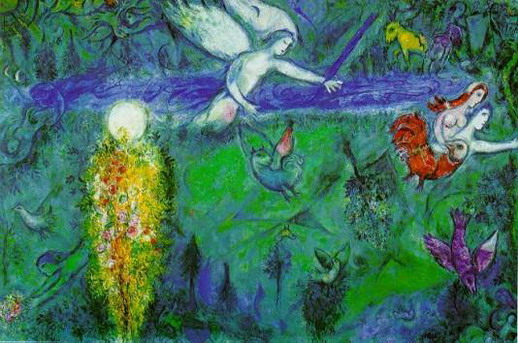
Featured Image: Marc Chagall, Song of Songs III, 1960
Chapter summaries and reflections on Song of Solomon 1-3
In the first chapter of Song of Solomon, the Shulamite woman seeks the kisses of the king’s mouth, symbolizing the believer seeking the words of God. When we hear what God speaks it heals us and drowns out the lies and distractions of other voices. This is what is meant in “your love is better than wine” (NKJV, SOS 1:2). The fruit of this intimate dialogue of prayer with the Lord and listening to His words in meditation of the Word comes in verse four when the Shulamite exclaims with the daughters of Jerusalem (representing immature believers), “we will run after you” (SOS 1:4). The love of God and the personal relationship experienced between the believer and God is greater than not only sin but the good and best pleasures in this life. Next, the Shulamite understands the paradox of grace, saying “I am dark, but lovely” (SOS 1:5). Although we, as believers, are sinners in a messy process of sanctification, we are heading towards a bright future with a promised resurrection. In this, the Lord sees us through His eyes of grace. Because we are covered with the blood of Jesus we are seen as prized, purchased, and priceless. He is able to see our glorious end and rejoice in who we truly are, though it is not yet manifest.
In this chapter we can see that the first commandment leads to the proper fulfillment of the second commandment. When we love God with all our heart, mind, soul, and strength and find our identity in Him, we are able to love others as we ourselves are loved. The consequences of not finding our fulfillment and identity in God and what He says about us are endless and include burn out, becoming disheartened, confused, led astray, and much, much more. Without the understanding that our past or current weakness does not define us (but rather what does define us is what God says over us, His choice of us, and our promised future in Him), we are destined to continue to regress in our relationship with God, ourselves, and others. With such a revelation, the Shulamite is not content to hide in shame. She sees God leading the Church, called, “your flock”, and asks how she may join Him (SOS 1:7). Before even answering her question He affirms her, calling her the “fairest among women” (SOS 1:8). God, in this way, as mentioned previously, calls forth that which is not yet manifest in us as it is being made true. This is a book of affirmations of the truths of God’s heart towards His bride: the individual believer, Israel, and the Church. He exhorts the bride, the Shulamite, to be led and to lead, saying “follow” . . . and “feed your little goats beside the shepherd’s tents” (SOS 1:8).
Again, the first commandment followed by the second commandment is played out. That is, we ought to walk with God in context to spiritual covering as we continue in ministry. Furthermore, God
compares the bride with “a lily among thorns” (SOS 2:1). Meaning, in the dark world God sees the Church as his beautiful prize. On the other hand, the bride compares God to “an apple tree among the trees of the woods” (SOS 2:3). She sees that in the dark world, God is the only one who can provide and sustain for her among all the people of the world. This kind of spiritual walk in community and allowing the Lord to operate through us in the gifts He has given us must flow out of a right relationship with Him. Just as the book of James shows, faith without works is dead, so the fruit of our life reflects what we truly believe. Although the bride of Christ is a light in the darkness, exalting God to the world as she functions in the works of God, her beauty and identity is first and foremost defined by her relationship to God.
The bride desires to stay in this kind of honeymoon phase of her interaction with the Lord, resting
in His words over her, which are as a “banner” of “love”; however, He comes to wake her and call her
away to the mountains with Him, to conquer her fears and sins and to grow in relationship with Him
(SOS 2:4-15). At first she says no, not out of rebellion but out of immaturity, saying, “turn, my
beloved” . . . “upon the mountains of Bether” (SOS 2:17). “Bether” means “cleft” and speaks of
separation. In the third chapter she finds that her compromise to the Lord has led to the drawing away of
His presence from her. This causes her to rise and seek Him. Often in our life when we ask why God has
withdrawn His presence, it turns out He is waiting where we left Hm: at the very place where we said no.
There is no skipping courses in the university of God, so to speak. In love, God will withdraw His
presence to push us forward in seeking Him. When she finds the Lord she clings to him and is determined
to never let Him go (SOS 3:4). This is where the bride receives her revelation of the cross (SOS 3:6-11).
She sees the death of Christ, His conquering victory, and the glorious soon coming “day of his
wedding” (SOS 3:11). Meditating on the love and power of Christ as seen in His work on the cross
empowers us to face the conflicts and challenges of this life. It empowers us to walk out repentance and
forgiveness in wholehearted obedience and to walk with Him in intimacy towards a closer unity with God
in His holiness and in the vocation He has for us.
We need these truths to penetrate our hearts. These verses are not mere poetry to be enjoyed, for they speak of eternal truths. Nonetheless, the poetry is a tool we are to use in order to connect with reality. We ought to use these verses in prayer and allow them to become personal to us and to invade our hearts. By bringing the Song of Solomon into our prayer lives through meditation, journaling, singing, and even
through the arts, we give our hearts the space it needs to wrestle with and agree with God’s truths. The beauty of this book is that we are able to slow down and connect with small phrases at a time with our understanding and agreeing with the truth, often with repentance for agreements with lies that resist God’s love. Perhaps a phrase such as “your love is better than wine” does not ring true, but just by sitting with God and agreeing that this is a biblical truth we allow God to conform our lives into His image and His will. (SOS 1:2) This leads us to repent of falsehood and allows God to invade those parts of our hearts that we hide even from ourselves.
Our lives will show the fruit of either our agreement or disagreement with these truths. Typically, disagreement with these truths lead to many negative traits. For example, not believing God’s paradox of grace over our broken lives will cause us to treat others the way we feel about ourselves. When we don’t see grace over ourselves, we don’t see grace over others. These prayers also bring conviction to places in our hearts where we have become hardened and have stopped repenting and have been regressing. Declaring the truth of God’s Word ought to be a regular part of prayer, and Song of Solomon is especially important in understanding our identity in God and the heart of God toward us. It will smooth over our rough places, heal our hearts, and conform our bent nature to stand tall in God’s holiness. For, we are children of God called to enjoy and reflect the heart of our Father.
 ...and in his temple all cry, “Glory!”