Ἔργων Νόμου,[1] translated “works of the law,” [2] occurs eight times[3] in the Pauline epistles and is a key theme throughout the book of Romans. The phrase appears in Romans 3:20 where Paul concludes the first part of his argument regarding the nature of salvation in relationship to the works of the law:
“. . . διότι ἐξ ἔργων νόμου οὐ δικαιωθήσεται πᾶσα σὰρξ ἐνώπιον αὐτοῦ, διὰ γὰρ νόμου ἐπίγνωσις ἁμαρτίας.”
“. . . because by the works of the law not any flesh will be justified before him, for through the law is knowledge of sin.”[4]
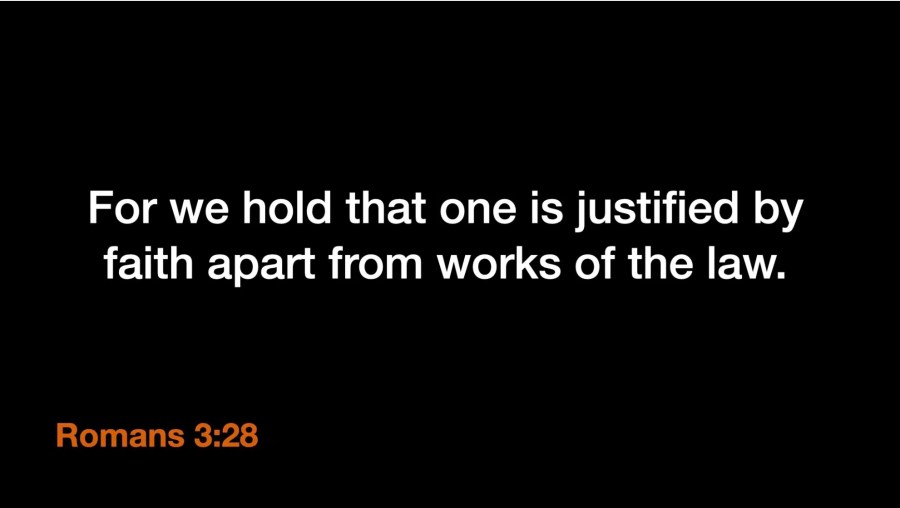
This conclusion ties back to his thesis in Romans 1:16-17. That is, the Gospel of Christ, wherein the righteousness of God is revealed, is the very power of God unto salvation to those who believe, “apart from the works of the Law” (Rom 3:28).[5]
Νόμου has a range of meaning and can refer to a general custom or requirement, a moral instruction, the Pentateuch, or the entire Mosaic law, depending on context. It is widely understood among scholars that Paul here refers to the law as a whole—that is, the Mosaic law given through Moses, including the Ten Commandments, the Levitical code, and the Torah as a whole. While some argue that Paul is using ἔργων νόμου pejoratively, namely as a legalistic framework of works versus grace, others argue from a contextual understanding of first-century Judaism and what is known as the “New Perspective on Paul.”[6]
In his work Paul and Palestinian Judaism, E. P. Sanders argues that Palestinian Judaism (200 B.C.E.–200 C.E.) did not put forth a legalistic religion of salvation by works, but rather a system of “covenantal nomism.”[7] Wherein, Judaism understood salvation as a participation in the covenant through God’s election of grace, with obedience to the law serving to maintain that covenantal relationship. This forms a major context for Paul’s letter to the Romans and his understanding of ἔργων νόμου. Against this covenantal nomism, Paul does not present an argument for salvation against grace versus works, nor a focus on an apocalyptic salvation, but rather, what Sanders calls “participationist eschatology” in which salvation is experienced through union with the life, death, and resurrection of Christ both now and at His Second Coming.[8] Thus, Sanders sees that the first-century Jews always understood salvation to be an election of grace that could be forfeited by disobedience to which Paul introduces an entirely new framework of salvation.[9]
In his essay The New Perspective on Paul, James D. G. Dunn builds on Sanders’ perspective, showing how covenantal nomism resulted in distinct “identity markers” that were “seen as badges” to indicate “what membership of the covenant people [involved],” and that functioned to “demonstrate covenant status.”[10] These included circumcision, dietary laws, and Sabbath observance, among others.[11] This in turn, Moo says in his commentary The Letter to the Romans, worked to create a “special status” whereby the Gentiles could be deliberately kept out.[12] This is underscored by the boasting Paul addresses in 3:17. Under these frameworks, Paul’s argument is not against the works of the Mosaic law in themselves, but against Israel’s “identity crisis” and the notion that justification (and later, Israel’s election) could be secured by the keeping of the law.[13] On the contrary, Paul shows that the law serves only to reveal sin and cannot make anyone righteous.
In The Epistle to the Romans: A Commentary on the Greek Text, Longenecker pushes back on Sanders and Dunn, arguing that first-century Judaism can often “only be called ‘legalistic’ and not ‘nomistic.’”[14] He contends that restricting the interpretation of ἔργων νόμου to covenantal nomism or identity markers is to “twist the evidence in support of an alien thesis.”[15] He provides evidence that some Jews practiced a form of works-based righteousness, and while Dunn and Sanders are commendable for correcting anti-Semitic readings of Paul, they ultimately downplay the legalism inherent in ἔργων νόμου.[16] Schreiner agrees and demonstrates how legalism can come down to perspective. Where the Catholics defended God’s grace during the Reformation, Luther saw works-righteousness present. He argues that viewing Judaism as a legalistic religion is not necessarily anti-Semitic, since ultimately Israel only demonstrates the universal sins of humanity inherent in works-righteousness.[17] In this same line of thought, Moo maintains that Paul uses the phrase pejoratively as a “religious aphorism” to critique the attempts to achieve righteousness through the law itself. Moo notes that instead of Paul zeroing in on Jewish works regarding Jewish identity, Paul instead links ἔργων νόμου with “doing ‘anything good or bad’” in Romans 9:11-12.[18]
In his work entitled, “’Works of the Law’ in Paul,” Thomas R. Schreiner agrees that, to some degree, Paul was coming against Jewish identity markers that were either being imposed upon or else excluding Gentiles. Nonetheless, he sees Dunn’s treatment of ἔργων νόμου as too narrow and that, ultimately, Paul rejects the works of the law because they are impossible to keep and promote a works-righteousness. Paul’s focus, he shows, is on the broader Mosaic law which is evidenced by the immediate context. For instance, Romans 3:19-20 concludes Romans 1-2 where the law is spoken in terms of actual practice or obedient observances that the Jews are failing at—not in terms of identity markers (2:13, 23, 25, 27). Paul finds that the Jews have failed to keep the law in contrast to Gentiles who, from their conscience, do obey the law.[19]
Schreiner discusses L. Gatson’s views as well. Gatson, who interprets ἔργων νόμου as a subjective genitive,[20] sees the works as coming from the law, which would be how Paul similarly treats other subjective genitives such as the works of the flesh or the fruit of the Spirit (Gal 5:16-26). To Gatson, the works of the law cannot save because “Paul sees the law as bringing a curse (Gal 3:10), failing to accomplish righteousness (Gal 3:21), causing guilt (Rom 3:19), revealing sin (Rom 3:20), increasing sin (Rom 5:20), deceiving (Rom 7:11) and killing (Rom 7:10-11).”[21] Schreiner is not compelled by Gatson’s argument, in that Paul’s argument is that the law is good despite these (Rom 7:12). On the other hand, he notes that Paul opposes righteousness through the law not because the “works are evil,” but “because no one obeys the law perfectly.”[22]
In regards to the boasting that follows the pursuit of such works scholars argue: “Paul is not speaking against boasting in meritorious achievement” here in Romans but against Jewish pride in their election and national privilege as it pertains to salvation, or the “perception of special status or privilege,” they think they are receiving.[23] Schneider points out that Paul’s comparison between Abraham’s faith and later recipients of the law is not in regards to obedience but in regards to how righteousness is received. In this, some scholars see Paul’s argument as not against legalism per se, but that the Mosaic law “by definition could not justify, and thus Paul polarizes law and faith.”[24] That inability resting on the weakness of human flesh to obey it perfectly (Rom 8:3). In this understanding, Schreiner concludes, Paul “is speaking against those who would boast because they tried to obtain salvation,” not because the very act of it is sinful, but because it is impossible and futile.[25]
Of course, Sanders’ understanding is that Judaism saw their salvation as given by grace and works as maintenance of the covenant—that the attempt to attain one’s own righteousness is not present in “works of the law” in the historical context. To this, Schreiner argues that it is typical of Paul to address real issues going on in various church contexts. Paul would not stress this point if it did not exist. Though a works-salvation may not be fully supported by the broader understanding of Palestinian Judaism, it can be understood as the apparent context of Romans according to the text itself. He makes the point, at all, because some were attempting it. Schreiner goes on to argue that Jewish nationalism was “intimately and inextricably” tied up with the works of the law.[26]
Further, Schreiner agrees with the Bultmann school that Paul opposes legalistic works-salvation (a human sinful propensity) but disagrees with their claim that attempting to follow the law is inherently sinful. He argues that perfect obedience of the law would indeed make one righteous, but the real issue is the human inability to perfectly obey the law. He challenges Klein’s view, that the law is opposed to faith, since the curses that come from the law are not from the works themselves but from the impossibility of completing them. Boasting, then, is only wrong in they were, in reality, not completed. Abraham’s faith, here, proves the sufficiency of faith in light of the inability to complete the works.[27] Ultimately Schreiner concludes that Paul’s dealing with the works of the law is a rejection of the illusion that humanity could possibly fully obey them and attain righteousness before God.[28]
In conclusion, it is likely that many of these factors highlighted by the above scholars are accurate. While some Jews may have understood themselves as being sustained in a covenant of grace by good works, it is clear from the text itself that there was also a misunderstanding that righteousness could be merited by the good works of the law. These good works of the law were not, in actuality, fully kept, yet there was boasting both in incomplete works and in a national identity of salvation. Elements of racism or exclusion, aimed at keeping the Gentiles out, were likely to also have been present in Palestinian Judaism in general. This reflects a broader human tendency across religion and social groups. Paul is likely addressing in on a multi-layered issue that involved not only the human inability to keep the law at all, but a self-righteous and legalistic attitude that stretches back to Adam and Eve’s sewn fig leaves in the garden. In this framework, the pursuit of the law, whether sinful in and of itself or not, inevitably encounters major roadblocks (self-righteousness, idolatry, and futility) to the righteousness won by Christ. The danger, however, is not in performing good works, but in trusting in them for salvation. Paul’s critique of works of the law is therefore universally significant: justification cannot be attained through human effort, and legalism reveals the futility of all such attempts to justify oneself.
Paul ultimately ties ἔργων νόμου into the broader theme of the universality of sin between Jews and Gentiles. His argument is not merely against Jewish laws but against all forms of human merit. The law and its required works, limited by human weakness (Rom 8:3), only prove the sinfulness and depravity of humanity (Rom 7:5). “The law came alongside”[29] (Rom 5:20) Israel for this very reason, to point back to the faith of Abraham that salvation is by faith in Christ alone. The focal point of justification is redirected solely to Christ, wherein all covenantal participation with God, including Israel’s national election, is defined by faith (Rom 4:13; 9:11, 31-32).
Faith in Christ is now the defining requirement for inclusion in the people of God, rather than ritual or ethnic markers. Believers are now dead to the boasting of self-righteousness as well as to the requirements of the law so that they would by the Spirit fulfill the law of love through faith (Rom 3:31; 7:4; 8:4; 113:8-10).
BIBLIOGRAPHY
Dunn, James D. G. Jesus, Paul, and the Law: Studies in Mark and Galatians. Westminster: John Knox Press, 1990.
Gatson, Lloyd. Paul and the Torah. Eugene, OR: Wipf & Stock Publishers, 1987.
James D. G. Dunn. The New Perspective on Paul. Revised Edition. Grand Rapids, MI: William B. Eerdmans Publishing Company, 2005.
Klein, Günter. “Sündenverständnis und theologia Crucis bei Paulus.”Theologia Crucis—Signum Crucis: Dinkler FS. Ed. C. Andresen and G. Klein. Tübingen: J. C. B. Mohr, 1979.
Longenecker, Richard N. The Epistle to the Romans. Eerdmans, 2016. EBSCOhost. research.ebsco.com/linkprocessor/plink?id=87e4772c-1d8d-3c35-800a-40b270f0d4e9.
Moo, Douglas J. The Letter to the Romans. The New International Commentary on the New Testament. Second Edition. Grand Rapids, MI: William B. Eerdmans Publishing Company, 2018.
Sanders, E. P. Paul and Palestinian Judaism: A Comparison of Patterns of Religion. Minneapolis, MN: Fortress Press, 1977.
Schreiner, Thomas R. “‘Works of Law’ in Paul.” Novum Testamentum 33, no. 3 (1991): 217–44. https://doi.org/10.2307/1561358.
[1] Unless otherwise indicated, all Greek New Testament references in this paper are taken from: Aland, Barbara, et. al., eds, The Greek New Testament, 5th ed. (UBS5), (Stuttgart: United Bible Societies, 2014).
[2] Author’s translation.
[3] Thomas R. Schreiner, “‘Works of Law’ in Paul.” Novum Testamentum 33, no. 3, (1991): 217, https://doi.org/10.2307/1561358 (2 April 2026).
[4] Author’s translation.
[5] Author’s translation.
[6] James D. G. Dunn, The New Perspective on Paul, Revised Ed., (Grand Rapids, MI: William B. Eerdmans Publishing Company, 2005).
[7] E. P. Sanders, Paul and Palestinian Judaism: A Comparison of Patterns of Religion, (Minneapolis, MN: Fortress Press, 1977), ix, 33-58, 428.
[8] E. P. Sanders, Paul and Palestinian Judaism: A Comparison of Patterns of Religion, 514-552.
[9] E. P. Sanders, Paul and Palestinian Judaism: A Comparison of Patterns of Religion, 543.
[10] James D. G. Dunn, The New Perspective on Paul, 111, 191-194.
[11] James D. G. Dunn, Jesus, Paul, and the Law: Studies in Mark and Galatians, (Westminster: John Knox Press, 1990), 11, 28.
[12] Douglas J. Moo, The Letter to the Romans, The New International Commentary on the New Testament, Second Ed., (Grand Rapids, MI: William B. Eerdmans Publishing Company, 2018), 218.
[13] James D. G. Dunn, Jesus, Paul, and the Law: Studies in Mark and Galatians, 223.
[14] Richard N. Longenecker, The Epistle to the Romans: A Commentary on the Greek Text, (Grand Rapids, MI: William B. Eerdmans Publishing Company, 2016), 365.
[15] Longenecker, The Epistle to the Romans: A Commentary on the Greek Text, 365.
[16] Longenecker, The Epistle to the Romans: A Commentary on the Greek Text, 326-377.
[17] Thomas R. Schreiner, “‘Works of Law’ in Paul,” 241-243.
[18] Douglas J. Moo, The Letter to the Romans, 219; see also Rom 2:15.
[19] Thomas R. Schreiner, “‘Works of the Law’ in Paul,” 226.
[20] Lloyd Gatson, Paul and the Torah, (Eugene, OR: Wipf & Stock Publishers, 1987).
[21] Thomas R. Schreiner, “‘Works of the Law’ in Paul,” 221.
[22] Thomas R. Schreiner, “’Works of the Law’ in Paul,” 231.
[23] Thomas R. Schreiner, “’Works of the Law’ in Paul,” 233.
[24] Thomas R. Schreiner, “’Works of the Law’ in Paul,” 233-234.
[25] Thomas R. Schreiner, “’Works of the Law’ in Paul,” 234.
[26] Thomas R. Schreiner, “’Works of the Law’ in Paul,” 234-236.
[27] Thomas R. Schreiner, “’Works of the Law’ in Paul,” 240-241; see also Günter Klein, “Sündenverständnis und theologia Crucis bei Paulus,” Theologia Crucis—Signum Crucis: Dinkler FS, ed. C. Andresen and G. Klein (Tübingen: J. C. B. Mohr, 1979), 249–282.
[28] Thomas R. Schreiner, “’Works of the Law’ in Paul,” 241-244.
[29] Author’s translation.
 ...and in his temple all cry, “Glory!”